

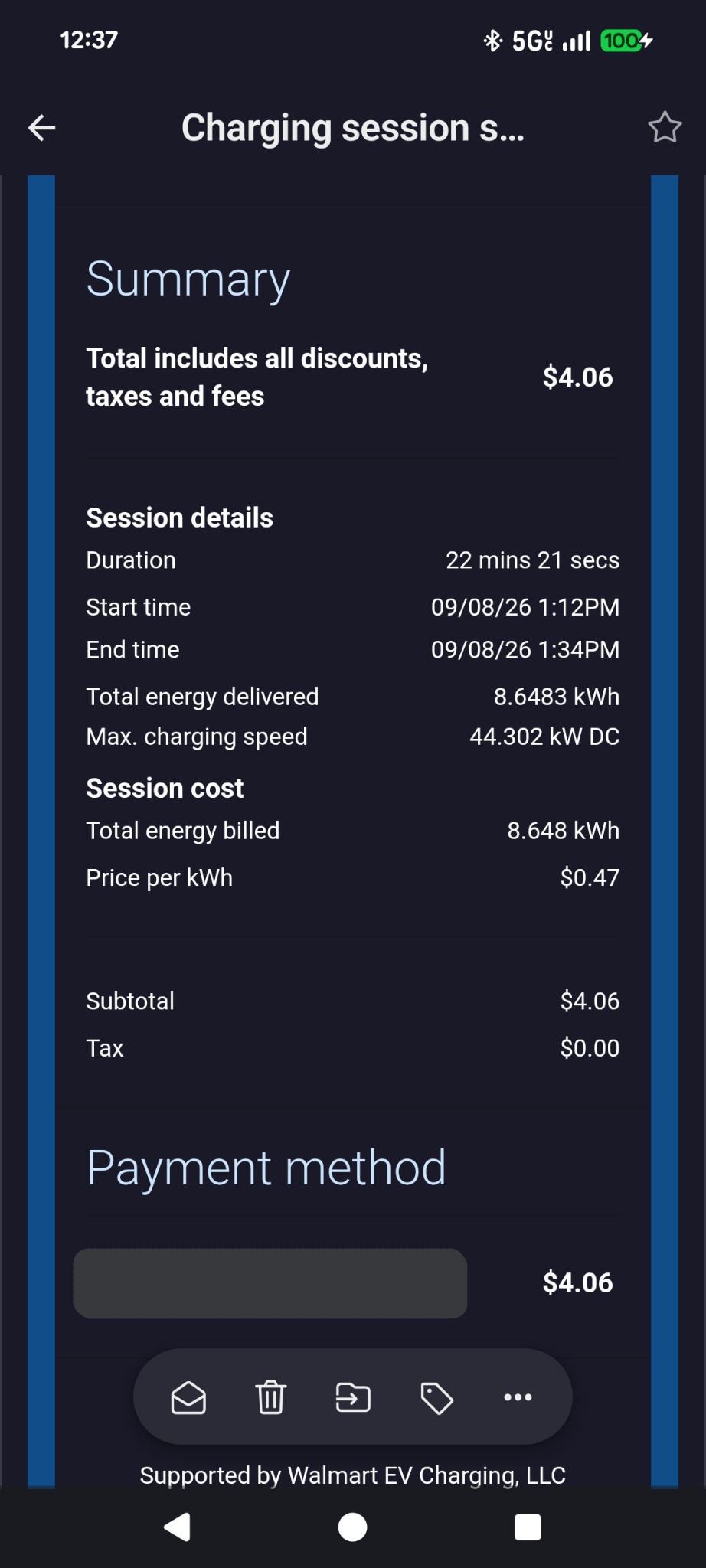
In Chicago area for anyone wondering using the Walmart charging network. This is about ~13% capacity, wasn’t really low started charging at about 70%.
In Chicago area for anyone wondering using the Walmart charging network. This is about ~13% capacity, wasn’t really low started charging at about 70%.
Gas car: cost per mile = price per gallon ÷ miles per gallon
Let’s assume 30 mpg and $4.50 a gallon, that’s $0.15 per mile.
Electric car: cost per mile = price per kWh ÷ miles per kWh
Let’s assume 3.5 miles per kWh and residential rates of $0.14 per kWh, that’s $0.04 per mile.
Fast chargers will push the cost much higher in the US. They can charge $0.60 per kWh or higher at peak hours, which would put you at $0.17 per mile in the same car. There are ways to bring that cost down too if that’s your only way to charge.
Would also note that this charger was 47¢/kwh. That’s $0.134/mile - very close to the gas calc you did
So OP is talking about spending only $4 to top up, but that’s basically the equivalent of buying a gallon of gas at this energy price. Basically you need to charge at home to get the pricing benefits over gas.
Obviously a bunch of other benefits to EVs
With other benefits you mean like no oil changes or longer lasting brake disks and pads?
Yeah and better for GHGs obviously
And depending on use case, can be more convenient than gas - if you only have a basic commute and can charge at home. But gas may still be more convenient for some people (long distance in rural or remote areas for example; apartment living for another)
Thanks for the breakdown!
The only thing I would add to Dogyote’s EV math is a lot of states (like Ohio) charge extra for EV registration ($200 more in Ohio). So if you drive an average of 12,000 miles per year, that extra registration fee account for an additional 1.667 cents per mile. But its still 10 cents cheaper per mile vs gas. Gas would have to cost less than $2 to compete price wise.