

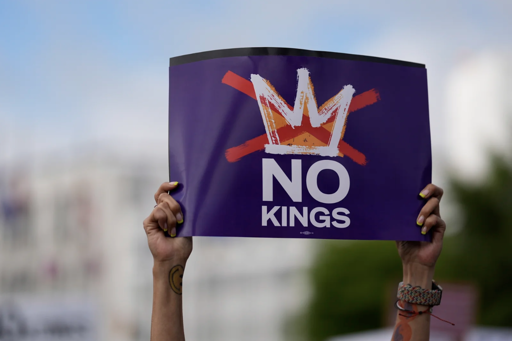
On March 28, 2026—two months after Trump’s gestapo forces murdered Alex Pretti and Renée Good—nearly 9 million people took to the streets to declare “No Kings” for the third time. The progressive organization behind the protest, Indivisible, declared it the largest single-day demonstration in American history.
But six months later, with November midterms fast approaching, ICE continues to kidnap immigrants from their homes and Trump is not an inch closer to being convicted and removed from office. A fourth No Kings event is just days away and some organizers have begun to question what exactly the group is demanding.
Indivisible was founded in the wake of Trump’s first election by husband and wife Ezra Levin and Leah Greenberg, both former congressional staffers. In December 2016, alongside a group of colleagues, the couple published a 26-page digital guide to resistance on Google Docs (the Indivisible Guide). The handbook quickly went viral and thousands of local Indivisible chapters began to spring up across the country, demanding Trump’s impeachment and removal from office. Democratic leadership was not amused, citing the need to stay focused on policy rather than accountability. Nancy Pelosi said the party should cultivate the image of being the “‘no drama’ Democrats.”
Ten years later, the Democrats are still reluctant to impeach Donald Trump and hold him accountable for his crimes and unconstitutional actions. Indivisible, known for its most-prominent visual, a logo of a crossed-out crown above the words “NO KINGS,” seems to have joined them in this.
Despite its origins as a movement dedicated to helping citizens pressure elected officials into resisting the Trump agenda, Indivisible National has not endorsed Trump’s impeachment, telling a local chapter via email that it is “not an endorsed priority” for the No Kings! Coalition. In Montana, the organization went further, requesting that the same chapter not use the “No Kings!” logo or branding for their impeachment-focused event—and threatening to remove them from statewide communications after they didn’t comply. That dispute followed another undemocratic intervention in the state’s politics: a campaign by Indivisible National to convince Alani Bankhead, the Montana Democratic nominee for U.S. Senate, to withdraw from the race. (Levin and Greenberg did not respond to Current Affairs’ request for comment, or an interview.)
These incidents raise questions about the direction of one of the country’s largest anti-Trump organizing networks. Is the country’s leading resistance group still focused on “resistance,” or has its strategy become increasingly concerned with preserving the Democratic Party’s electoral prospects?
also the data you can collect based on who goes to them is highly valuable too.
Had some friends and family RSVP to these events and it was wild to me.
RSVPing to a protest is hilarious. Do you get a special No Kings badge you can put on your Facebook page, like a cert on LinkedIn?