

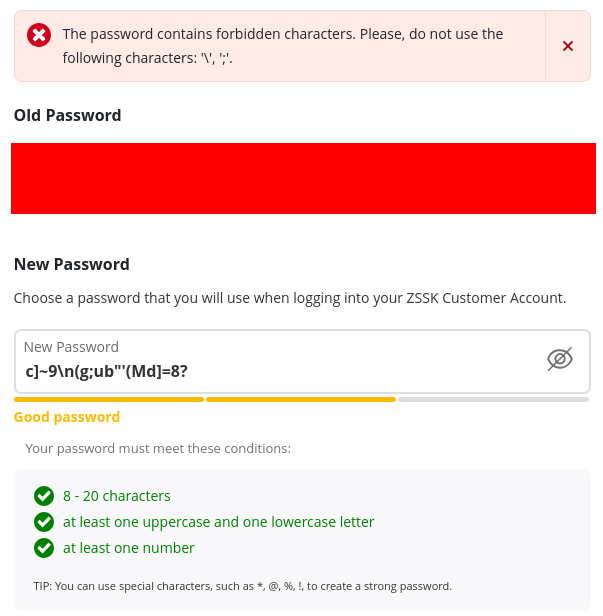
https://konto.zssk.sk/zk/new#step1
Also, it only seems to show “Strong password” if any of these characters is used: !@, and not other special characters.
Can I take the opportunity to ask a question?
I work at multinational EU company, we run windows/office for the enduser. There are many parallel systems, some running linux or whatever but that’s besides the point
But there was this audit, performed by an external company, at request of the holding (mother company) that revealed unsafe passwords that contained company name in it. According to the auditors that’s a big no no
My question is: how tf do they even find out that the passwords have some specific string in it? Is it not being salted? That would surprise as our IT/network management team is very capable, and relies on windows tools that should be safe to begin
Just how?
Related: Our security auditor is an idiot.
I would bypass anyone trying to agree and go straight to the CEO or president. How does this person have “security” in their title?!
That may very well be the case
My guesses would be that either:
It goes without saying that if they found a vulnerability with the hashing or salting, it should be highlighted on its own, and in any case it wouldn’t do damage to ask them directly.
Or a fake phishing company email that asked employees to log in. That would expose employees who were a high security risk as well.
Ooh, that’s evil… I like it
Thanks, it’s probably a combination of the above or even all of them
And like another user shared, they may just be idiots
I just wanted to confirm, there must be plain text databases, they got access to, maybe from some of the less secure systems, on the shop floor or wherever that may have unsecured protocols (they’re inside the corporate network, not directly connected to the internet)
But I’m going with idiots
They could have cracked the password hashes, most likely collected NetNTLMv2 hashes, using a generated list of weak passwords using the company name + a possible ruleset with hashcat.
Some audits still do it against all NTLM hashes stored on the AD DC, but it fell a bit out of fashion because most orgs don’t feel comfortable giving out that data for a pentest.
NetNTLMv2 and NTLM hashes are also still notoriously easy to run dictionary and combo bruteforce attacks on with GPUs.
You can see the benchmark for an RTX 5090 here: https://gist.github.com/Chick3nman/09bac0775e6393468c2925c1e1363d5c
It can do a whopping 340.1 GH/s for NTLM and 16017.9 MH/s for NetNTLMv2
Compare that to a Linux’s default yescrypt which didn’t even have official support in hashcat until this year because the hashrate would be a measly 70-200 H/s.
How feasible is it to attack argon2id with that method?
argon2id is one of those newer algorithms created specifically to make cracking infeasible and protect against certain side channel attacks.
An example performance from an Nvidia 90HX for LUKS is:
So correctly implemented, basically impossible lol.
Hashcat also added recent support for argon2id standalone and keepassxc db, so I’ll see if I can run my own benchmark just to see what it shows.
Thanks! I was curious because I am using keepass and I do use argon2id lol. I was a bit skeptical because the 2s benchmark parameter seems oddly small, but nice knowing that it is actually quite good.
On a GTX 1660:
-------------------------------------------------------------------------------
* Hash-Mode 34300 (KeePass Argon2 (KDBX v4)) [m=65536, t=2, p=2] [Kernel: pure]
-------------------------------------------------------------------------------

Speed.#01........:      434 H/s (75.99ms) @ Accel:67 Loops:4 Thr:32 Vec:1

-------------------------------------------------------------------------------------------------------------
* Hash-Mode 70000 (Argon2id [Bridged: reference implementation + tunings]) [m=65536, t=3, p=1] [Kernel: pure]
-------------------------------------------------------------------------------------------------------------

Speed.#*.........:       39 H/s

--------------------------------------------------------------------
* Hash-Mode 36100 (yescrypt) [N=4096, r=32, p=1, t=0] [Kernel: pure]
--------------------------------------------------------------------

Speed.#01........:      431 H/s (164.40ms) @ Accel:264 Loops:2048 Thr:32 Vec:1
For some context, my keepassxc on my PC registers about t=50 for a 1 second unlock delay, so the example benchmark t=2 is faster than an IRL example, hence why the reference argon2id is much lower with only an additional transform round (t=3).
But yeah it’s definitely good, and since argon2id allows you to set the parameters (memory, transform rounds, parallell) you can go make it hilariously indestructible if you feel like waiting like 30 seconds to unlock a DB lol.
Is there using Windows active directory tools than there is no way an auditor can have any possible idea what anyone has set their password to. Of course they might have simply asked the question and maybe some people would dumb enough to provide the answer but there’s no way they can technologically find out.
The only thing I can think of is that active directory will sync the password to other systems so if those are the systems were insecure perhaps that way you could access the data? I’m not really sure how AD handles SSO