- cross-posted to:
- linux@programming.dev
- cross-posted to:
- linux@programming.dev
publicación cruzada desde: https://piefed.social/c/linux@programming.dev/p/2495581/yea
Linus be like:
- “I only care about the final results and the correctness”
- Me looks inside
- Final results are shit and code is just slop
Ahhh, I love AI and Linus and how they’re enshittifying everything /s
Seriously, how would anyone in their right mind think that AI can be used responsibly? The only acceptable level of AI use is zero or a negative number.
You must log in or register to comment.
Nothing says joy of programming like micromanaging a junior dev through text messages.
there is a ne fork of linux it’s called DSA linux
it’s just a name
it has fundamental principles that cannot be questioned which makes it better and will make it thrive and take over the open source world
or not
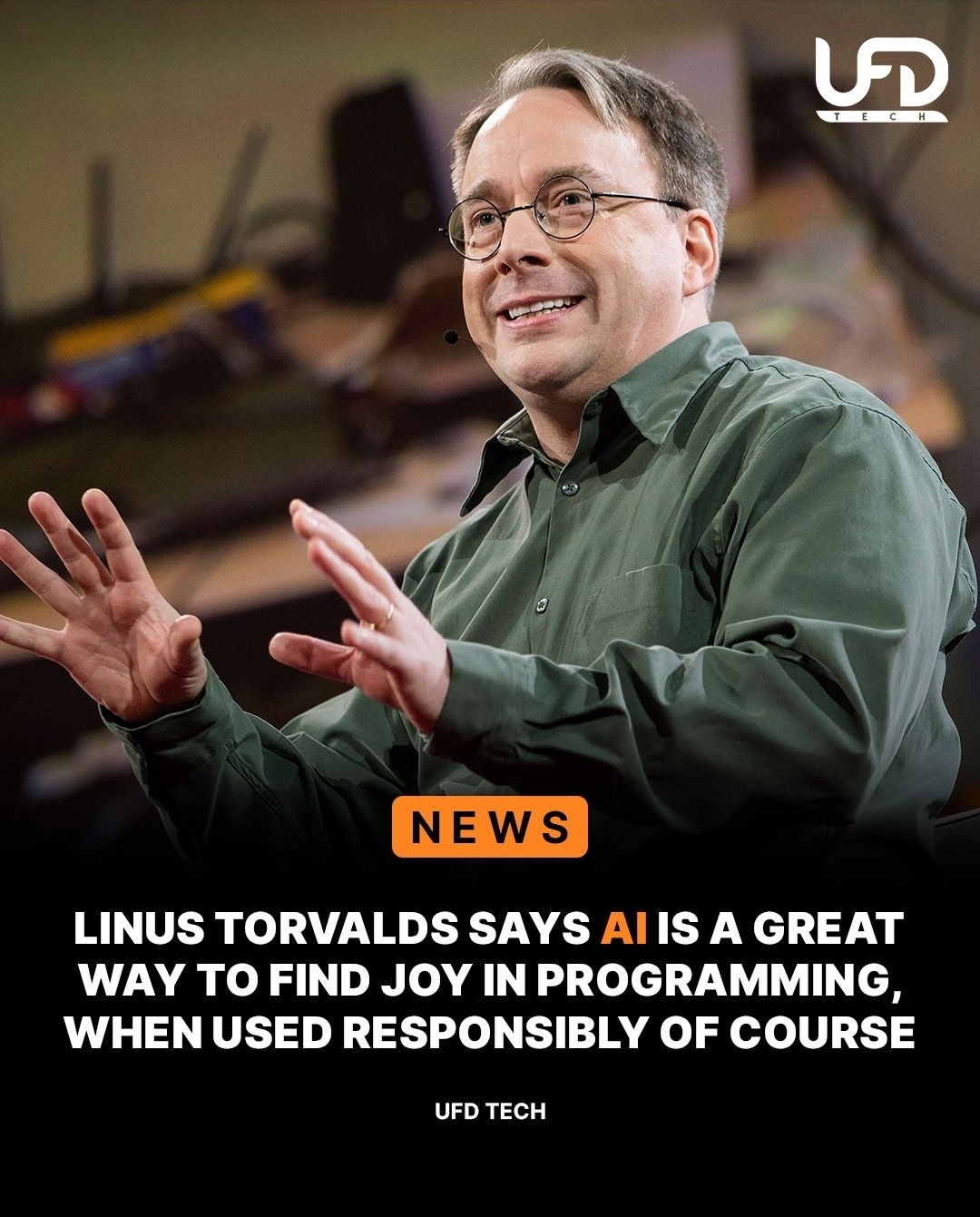
I’m gonna have to put some context here, because Linus’ opinion is alittle more nuanced than written here. I will say i don’t agree with him personally, but I also see where he’s coming from.
In multiple different interviews, now, Linus has lamented trash ai-generated code being pushed at codebases and flooding reviewers, so Linus is acutely aware of the problems caused by irrisponsible AI use. He sees how much people just push out AI slop without ever reviewing it. The thing is, Linus has been maintaining the linux codebase for over two decades now, and I imagine he is very aware of how much humans can pump out garbage code on their own.
He’s gone on the record, though, that he uses AI himself to rapidly create tools for troubleshooting and prototyping structures. As far as i can tell, he still views the final code as being something which should be written by a human, but he sees the value in being able to rapidly produce tools and test different data structure configurations in a few minutes where he’d normally have to jerry rig something together over a matter of hours prior.
I have not heard him weigh in on the environmental impact of LLMs yet, though I imagine he assumes that LLMs will become more efficient in time and that they’ll be less memory-intensive over time, to the point of being run locally on a desktop while still being just as powerful.( this part is one I have serious issue with, but i can’t fault the assumption since this guy literally started his career writing machine code by hand - not assembly, machine code.)
All AI use is irrisponsible use
Missing is his assessment that Vibe coding can be a nice on ramp to learning how to really code.
I’m super skeptical because I have never seen it happen in a newcomer, but it is pretty good at helping me find good candidates for libraries and how to use them consistent with my broader project design. So on ramp to a solid candidate from not knowing anything is gentler. Seeing the required arguments vaguely mapped to my existing data helps understand, even if I should throw out the generated code as being otherwise more trying than it’s worth, I still learned something useful.
A rare burst of nuance? Well done!
Yeah, but still: the only sane amount of AI is zero or a negative number.
I guess if your joy is outputting a lot of stuff. It’s really satisfying to actually learn things and we know llms disrupt the learning process.
Yeah im honestly not sure what to do about this. Id very much prefer not to have AI code in my OS kernel.
Time to code your own kernel. Good luck.
Yeah, I’m thinking about either supporting Redox, which is anti-AI and both POSIX and UNIX compliant although with some own extensions, or trying to find people to do an anti-AI hard-fork of Linux.
The core problem will be the amount of supported hardware that linux has.
As long as there is a compat layer that somehow brings the hardware things to other kernerls we couls move away from linux.
Or we can go through the temporary layer of reducing linux to just a virtual machine layer and put the alternatives on top of that layer meanwhile, hoping that linux doesn’t slopify too fast and gives us time to port.
Honestly, I think it can be helpful for beginners if used in moderation.
I’m a complete beginner with programming, and yesterday was working on my home assistant to control both my AC and Radiator simultaneously. But I couldn’t get it to work, with the special climate entity always crashing. After i think 2 hours, I asked Gemini what was wrong, and it pointed out that I didn’t have a fallback value and that when starting up, the values were invalid, and caused the entity to crash. After I added a fallback, it worked.
I think AI can be useful if you treat it like asking someone more experienced like a teacher. It will make mistakes, but if you’re stuck it might be able to help you. I’m still writing my code myself, but I use Gemini as a last resort when I’ve spend over an hour on a problem and can’t figure it out myself.
Not that that applies to Linus, but I thought I’d also add some context from a beginner
My hope is that he is smart enough to learn from this incident.
idk I just have joy in the process of making something. Software development is a creating craft, and devising components, getting into the nitty gritty of the application and putting it all together is where I get my joy from.
I don’t think any other maker would just replace their entire process of creation with a chatbot. Only the software engineer, the poor lost soul…
It seems to me agentic coders just hate every aspect of the craft, so they replace it with AI. Then what’s the point of even making software?
Unfortunately we live in a world that praises the economy not the enjoyment of the craft.
So how’s NetBSD for someone who’s experience with Linux/Unix has been Mint, Manjaro, Ubuntu and Fedora?
As someone who has used FreeBSD on and off for 15 years, I’d honestly say that you need to drastically temper your expectations if you think any sort of BSD will be comparable to a Linux-based desktop.
LLM agent code is good if you don’t try to one-shot things. Have it devise deterministic tests to test the code and give it the ability to check its own results via screenshots. Have it plan ahead, ask questions, work step by step in separate sessions. Give it enough context, always have it create a README.md explaining the structure and purpose of the project for other sessions. Fix some stuff yourself. It’s not either or, it can be both.
American LLM companies are terrible for their copyright infringement, the environmental effects of their data centers and for several other valid reasons. I hated that Microsoft tried to push Copilot on every system because it sucked (mandatory “I use Arch, btw.”).
So yes, LLM companies are terrible, people losing their jobs because of questionable business decisions is terrible. But LLMs are good tools. Like any tool, you can produce utter shit with it. You can use a screw driver to destroy the drive of an old screw and make it unusable. You can stick it in a wall and have a gaping hole. But you can also use it to remove and fasten screws regularly. The same applies to LLM agents. If you have got no idea what you’re doing, you may produce shit. The thing with shitty AI code is, you only notice it when it is shitty. Because the output that’s good is essentially invisible. The problem is not the tool, it’s who’s using it.
Use open-weight models locally and use a harness like Pi and expand it or modify it as you wish. Don’t support the per token pricing/subscription companies.
I don’t care if your code is good if the tool you used to write it for you causes so much harm to the environment and the people living near he data centers.
And even far away from them.
Don’t forget that AI is a labor-destroying, code-and-art-stealing and license-laundering machine.
Right, there are a lot of issues with IA that are worth criticizing. Pretending like it’s not getting pretty fucking good at coding and other stuff is counterproductive. If it wasn’t people wouldn’t use it more and more.
I didn’t say anything about how good it is at coding.
But, if you did ask me, I would say that as a professional software developer that now is forced to work with AI, it’s really not good at programming. I have to heavily hold its hand, and whenever a non-developer at my company tries making some software with AI, it’s either awfully unreadable code, full of bugs, or, most often, both. I’m working with all the latest Claude Code models btw.
And even if it were that good at programming, I still don’t think it’s worth the cost.
If it wasn’t [good at coding] people wouldn’t use it more and more.
This is a non-sequiter. There are thousands of reasons a person might use something that makes them worse.
People use bad things all the time. People are still on Twitter and Facebook and they both fucking suck. People still smoke.
That’s a valid point. I was just getting at OP’s point that “AI code is terrible”, which it can be, but doesn’t have to be.
Something has to be done about data centers, especially in the US. But that’s also why I believe promoting local inference is important. My local model runs on the sun on my roof, for the most part. It’s not causing environmental havoc. The training of new frontier models is. The training of new proprietary frontier models is disincentivized if you can’t make money with them anymore. Open-weight models are free and hurt Anthropic and the likes. But it’s also a matter of energy infrastructure and how the centers are built. That needs more regulation. It’s good that local backlash seems to have an effect.
I was just getting at OP’s point that “AI code is terrible”, which it can be, but doesn’t have to be.
I consider it to be, because of the factors I mentioned earlier. And yes, if local ethically trained models are used, I’m fine with that. The thing is that in the vast majority of cases, it’s not.