You must log in or register to comment.
It’s much easier to be a good person when you aren’t indoctrinated from birth with some book of ancient myths telling you who to hate.
Ironically, biblical morality is absolutely fucked in the head.
Killing women because they didn’t scream while they were raped (probably because the uncle or father or brother raping them was either choking them out or holding a knife to their throat or something worse.)
Killing infants and unborn children because someone 3 generations ago did a thing.
Stoning teenagers for being, you know, teenagers.
It really is a good thing morality doesn’t come from god.
The best part is when God goes " see that guy over there, he believes so much in me, i will torment him beyond reason to proof his dedication to me"
There are so many of these terrible examples of god being this huge asshole. When i read the bible in my early teens, it was reading the bible that ‘made me an atheist’. Seeing that people took this asshole god serious.
Over the years i did get to learn more about Jesus, he is the proto-hippy about sharing love and kindness. But somehow, very few christians follow up on his words and teachings. Christians actively chosing to be assholes when they have Jesus as a deity in their mythological fanfinction. It boggles the mind.
Yup, I don’t believe in God, if he is real, I wouldn’t want to follow him anyways…
I think my favorite morality-thing to bring up is Song of Solomon.
Especially when people get on about purity culture. It’s Bronze Age porn.
I mean, yeah. god is a raging asshole, but that one usually gets more entertaining reactions.
This is good. 'Our life is short and tedious, and in the death of a man there is no remedy; neither was there any man known to have returned from the grave. For we are born at all adventure, and we shall be hereafter as though we had never been; for the breath in our nostrils is as smoke, and a little spark in the moving of our heart, which being extinguished, our body shall be turned into ashes, and our spirit shall vanish as the soft air, and our name shall be forgotten in time, and no man shall have our works in remembrance, and our life shall pass away as the trace of a cloud, and shall be dispersed as a mist that is driven away with the beams of the sun, and overcome with the heat thereof. For our time is a very shadow that passeth away, and after our end there is no returning; for it is fast sealed, so that no man cometh again. Come on, therefore, let us enjoy the good things that are present, and let us speedily use the creatures like as in youth. Let us fill ourselves with costly wine and ointments; and let no flower of the spring pass by us. Let us crown ourselves with rosebuds before they be withered; let none of us go without his part of our volup- tuousness, let us leave tokens of our joyfulness in every place; for this is our portion, and our lot is this. 'The Wisdom of Solomon, ii, 1-9
This is pefaced with “And the ungodly say”

The Wisdom of Solomon, ii, 1-9
Most gods are huge assholes, though.
Not this one.

Sending bears after teenagers because they called you bald once is crazy Elisha.
Yup.
In the scope of things that’s fairly mild. I mean god once decided to bio-cide the entire planet. (or so we’re told, heh.) And that was because some angels game down and got it on with human women… who probably didn’t really have a choice…

Can you believe that any grown man or woman with the slightest knowledge of biology, geology, physics or any science at all, not to mention plain and simple common sense, can conceivably believe the biblical account of creation. With or without the story of the ark, the flood cannot account for the facts of geology and palaeontology. The arrogance to claim that these stories are “science” and that this “science” is just as compelling as that of thousands of geologists and biologists who have devoted their lives to careful observation, experimentation and logic.
The great flood? That was a nephilim thing?
Yeah. I mean it’s not the most explicit justification given, per se, but like here’s gen 6, where god decided to, you know, off everything except Noah:
6 1When people began to multiply on the face of the ground, and daughters were born to them, ^2 ^the sons of God saw that they were fair, and they took wives for themselves of all that they chose. 3 Then the Lordsaid, “My spirit shall not abide in mortals forever, for they are flesh; their days shall be one hundred twenty years.” 4 The Nephilim were on the earth in those days—and also afterward—when the sons of God went in to the daughters of humans, who bore children to them. These were the heroes that were of old, warriors of renown.
5 The Lord saw that the wickedness of humans was great in the earth and that every inclination of the thoughts of their hearts was only evil continually. 6And the Lord was sorry that he had made humans on the earth, and it grieved him to his heart. 7So the Lord said, “I will blot out from the earth the humans I have created—people together with animals and creeping things and birds of the air—for I am sorry that I have made them.” 8But Noah found favor in the sight of the Lord.
Chapter 5, is largely a list of men following the line of Adam through to Noah. Then chapter six kicks off with that little gem, so it certainly seems to be that the think that god found wicked is his children boinking his playthings. (Early on, they were monolatristic, believing in other gods but worshipping only one to exclusion. As they became monotheistic, the sons of god were now angels, not lesser gods.)
(Fun fact. The word used for the ark, just means “box”. Noah didn’t even build a boat. He built a box.)
A screenshot of a comment I made a while back. Link to original comment

oh I’m well aware of how awful the story is. Basically the entire point was to flex how powerful ‘god’ was.
I often use it as my answer to “you just hate god” because agreeing with that statement (with a good reason as to why) is more fun than denying it entirely
Not to mention the whole Exodus problem
The pharaoh was bad guy at first but then became a victim of Adonaiyahwehjehovahbob’s torture
(I didn’t mean to comment twice)
I mean, if you believe their stories, god told the first lie. so why would you believe his divinely inspired horror novel when it says someone is the bad guy?
(good news- the exodus never happened. you’d think that rivers turning to blood would be something somebody in egypt would have mentioned/written down. Or the frogs. or the locusts or the whole slew of dead first born sons.)
Not to get into a debate, but someone did write about (something that could reasonably be) it, potential motivated reasoning by the source aside. Sources from that far into the past (or even the relatively closer past) very rarely survive to the present day, especially literary sources (which tend to be written on papyrus that rots away), and even historians of relatively well-attested periods like Rome and Classical Greece basically have a few texts they rely on*, supplemented with archeology, epigraphy (inscriptions on stone) and straight up magic, and that’s a thousand years
before(edit: after) the period in which the Exodus is taken to have happened without the advantage of Medieval monks painstakingly preserving the material. Now the Egyptian corpus is uncommonly big (yay for the Sahara), but it’s also very fragmented. For the most part what we don’t and can’t know is orders of magnitude more than what we can know, and it’s not even like we’ve studied the whole Egyptian corpus (we haven’t; there’s a shortage of trained Egyptologists able to do that work), so it’s very plausible that an event of even that magnitude would just… not show up in a way we can recognize. So what I want to say is: Truth of the Exodus aside, our sources for ancient history are nowhere near that comprehensive. Three thousand years is a long time.*For example Roman military history basically entirely relies on two guys (Livy and Polybius), whose works very frustratingly only survive in part, supplemented by some less reliable sources and fragments. When talking about Alexander the Great it’s basically just Arrian, again supplemented by less reliable/comprehensive sources and fragments. And it can get worse; we get straight up nothing in the way of literature from Carthage. There’s a lot of dumb luck involved in what does and does not survive.
Nope. not really.
it’s an apologist website, and while that in of itself is not something to suddenly dismiss out of hand, it is something to take a skeptical approach towards. for example, there’s more than a few red flags in how they talk about things.
For example, when they’re talking about the discovery of the Tomb of Sobeknakht II, they’re grossly misrepresenting things. They describe an attack that led to the complete occupation- at least, for a time- of Egypt.
Except that the inscription in the tomb they’re talking about, claims that Sobeknakht was successful in his defense at Elkab. At the time Sobeknakht was alive, ‘Egypt’ wasn’t even one kingdom. it was split between the Thebans (Who Sobeknakht led) and the Hyksos to the north. this attack was was in, at the latest 1550 bce (Sobeknahkt II was ruling somewhere in the sixteenth and seventh dynasties.)
it’s this kind of gross- and lets be honest, probably intentional- misrepresentation to conflate that with the Kush Empire’s conquest of Egypt in 700-500 bce. there’s 850 years gap- at the most generous- along with multiple kingdoms and dynastic succession separating the events of Sobeknahkt and the conquest of the kushites in 700ish. Even to suggest that behavior in one case would be the way that Egyptians of another time and another place behaved elsewhere.
And that suggestion would in fact be somewhat wrong. we do have things in the archeological record that show Egyptians suffered defeat. We even have things in the historical record where they’re talking about those defeats and what happened how to keep them from happening again- including, as an example, the adoption of certain kinds of composite bows, the adoption of chariots were brought to Egypt by the Hyksos (asiatic peoples, less a race and more a class of people- that is the “foreign rulers”.)
I have to assume this was an intentional lie, given that it took all of five minutes for me to find whose tomb they were talking about and that they were talking about a military invasion a thousand years later as if Sobeknakht would be there. You’ll notice my opinion of apologists are rather low- this kind of lie is common, and either they’re to ignorant not to believe it or it’s intentional.
which brings us to the next thing.
The argument is “Well, just because we don’t have evidence, doesn’t mean there wasn’t evidence we just haven’t found yet.” The question that needs to be asked is should we find evidence? The historical record we have that mostly survives comes from monuments and inscriptions. things on tombs and such like (like the inscription on Sobeknakht’s tomb) lauding their accomplishments and victories. One certainly does not generally put shameful things on such tombs or monuments.
So no, we wouldn’t really expect to see much in the way of historical records. that is to say, we wouldn’t expect to find much in the way of writings- histories- on the defeats. Not by the Egyptians, anyway. any writings, as you note, would have fallen away and moldered into nothing, etc. But we would expect to find things in the archaeological record. That is- in the artifacts left behind. Things like the trash heaps that have pork bones in them- or no pork bones- or the kinds of weapons, tools, and armor, the vehicles, the remains of humans themselves, the fossil record. all that kind of stuff.
And, if those stories are true and accurate, we would expect to find evidence of those stories being true in the archaelogical record. For Manetho’s story, that would have included Avaris, which has been excavated extensively, finding evidence of the lepers and corrupted people and such like. For example, the wall that Manetho says Osareph ordered built. Avaris had a wall. It was built by the Hyksos in the 1600’s and served as their capital city; where as Osareph and Amenophis were probably in the mid 1400’s. or later.
Neither do we have any evidence at all that the 80,000 were forced to work in stone quarries, nor that they moved to Avaris, and subsequently got crushed by a force 300,000 strong, nor did Amenophis (possibly Amenhotep II or Akhenaten) have major campaigns that saw them removed from their own lands and hiding with nubians to the south. Which is ludicrious to imagine that the Kush would have harbored them. the Kush and the Egyptians did not get along particularly well. (that is to say, they absolutely hated each other.)
As you can see, we have the same reasons for discounting the Exodus narrative, as well. Most scholars believe that the two narratives are separate legendary accounts. It’s absolutely ludicrous that you would expect us to believe that 2-3 million Israelites somehow managed to live in the nile delta (where the population at the time is also estimated to number 2-3 million…) without leaving so much as a trace.
I think it’s a bit more complex than this.
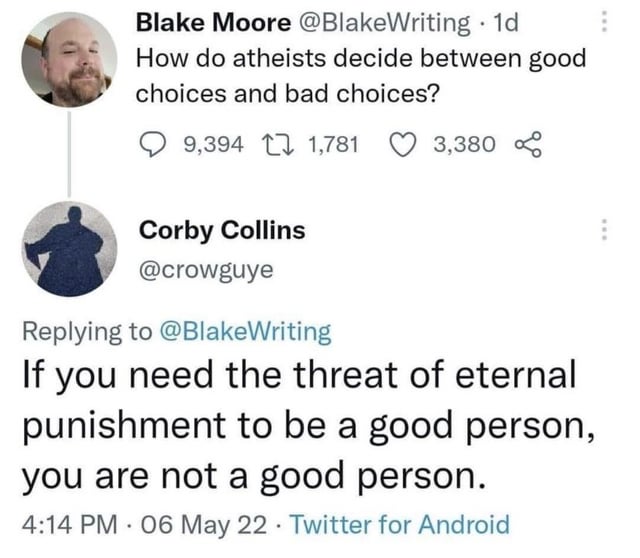
I think, in religious households, instead of being taught to be a good caring person you are taught to be as selfish as possible while staying within the rules.
So it’s not that religious need eternal threat of damnation, it’s that they have been taught to be as selfish as possible.
So I don’t think they lack morality naturally but they have been taught to be horrible people who obey laws.
Penn Jillette has a good explanation. I don’t agree with a lot he says, but this is pretty spot on. (The clip goes kinda off the answer after about a minute)
tl;dw: If you I don’t believe in a god, what’s stopping me from raping and killing anyone I want? And the answer is: I have. I already have. I have raped and killed everyone I want to rape and kill, and the answer is… zero. There are zero people I want to rape or kill. And the question becomes: Who are these people walking around with lists of people they want to rape and kill? Why do we consider THEM the sane ones?
We’re atheists and have raised our son (almost 10) as such, but always answer any questions he has about religion, especially since he hears it in school. He has no qualms telling friends he doesn’t believe in God and one friend told him he was going to hell. This was essentially my statement for him to use in the future andI love that he has no fear expressing himself.

By his Noodly Appendage!
True!

Since religious morality is made up by people it comes from the same source as atheist morality. Humans!
Religion tends to make it easy for people to insert shitty stuff and claim it is a divine mandate. Atheists have to make a case for why something is right or wrong.
‘Religion has mastered one remarkable skill: surviving without evidence. For thousands of years, gods have been proposed, worshiped, feared, obeyed, and defended yet never independently verified. This is not a minor oversight. In every other domain of human knowledge, claims without evidence are discarded. Only in religion are they protected, revered, and shielded from scrutiny. Atheism begins with a simple, unromantic question: Where is the evidence? Not the feelings, not the traditions, not the anecdotes but the verifiable, testable, independently confirmable evidence. When that question is asked honestly, belief systems that rely on revelation and authority rather than observation begin to wobble. Faith is often praised as a virtue. In practice, it is an admission of ignorance dressed up as confidence. Faith exists precisely where evidence does not. No one has “faith” that gravity works or that germs cause disease. Those are facts established through experiment and replication. Faith only enters when knowledge fails. If faith were a reliable path to truth, different religions would converge on the same conclusions. Instead, they contradict one another on every fundamental claim how many gods exist, what they want, who they favour, and what happens after death. Billions of believers, thousands of gods, zero consensus. Why should we treat any one of them as special? A popular apologetic claim is that religion “invented” science or was its primary driver. History tells a messier story. Scientific progress emerged when thinkers began questioning authority including religious authority and insisting on evidence over scripture. Copernicus, Galileo, Darwin, and countless others faced religious resistance, not encouragement. The Catholic Church condemned heliocentrism. Protestant leaders rejected evolution. Even today, creationism and intelligent design attempt to smuggle theology into science classrooms despite overwhelming biological evidence to the contrary. Another common claim is that without God, morality collapses. This argument misunderstands both morality and human behaviour. Moral systems existed long before monotheistic religions and vary widely across cultures. Empathy, cooperation, and fairness are products of social evolution, not divine command. If morality truly came from God, believers would behave demonstrably better than nonbelievers. They do not. Study after study shows no consistent correlation between religiosity and moral behaviour, and some of the least religious countries score highest on measures of social trust, equality, and well-being . Prayer Fails the Most Basic Test. Prayer is often described as powerful, transformative, and effective until it is tested. Controlled studies consistently show that intercessory prayer has no measurable effect on recovery, illness, or outcomes. In some cases, being told you are prayed for worsens outcomes due to performance anxiety. If prayer worked the way believers claim, hospitals would replace ICUs with chapels. They do not. Why? Because when lives are on the line, even believers trust medicine, not miracles. Why is scepticism encouraged everywhere except religion? Why are children taught to question advertisements, politicians, and strangers but not gods? Why is doubt framed as intellectual honesty in science and rebellion in theology? What would happen if religious claims were held to the same standards as scientific ones? If holy books were treated like hypotheses? If miracles required evidence before belief? Would anything remain? Atheism Is Not Nihilism It Is Responsibility. Atheism offers no cosmic rewards, no eternal surveillance, no divine forgiveness loopholes. That is precisely its strength. Meaning is not handed down; it is constructed. Morality is not outsourced; it is owned. There is no god to blame, no plan to hide behind. If this life is the only one, we know we have, then cruelty is less excusable, not more. Kindness matters now. Justice matters now. Truth matters now. And that is what makes atheism unsettling not that it removes meaning, but that it removes excuses. If faith is a reliable path to truth, why does it produce contradictory conclusions? Why are religious claims exempt from the standards applied to every other claim? If morality comes from God, why do moral intuitions change over time and culture? What belief would you abandon if evidence disproved it and why should religion be different?’
Is an action good because God commands it, or does God command it because it is good?
If it’s the first one, then all you’re saying is “God commands what God commands,” and assigning “good” to that is meaningless. If God commanded you to do evil things, then you would have to just blindly accept that as “good.”
If it’s the second one, then you acknowledge that there’s a source of morality independent of God that you’re judging God’s commands against to determine that his commands are good. At that point, you’re in the same place as the atheist, and it raises the question of why we need to listen to God as opposed to just going to the source.
This argument literally predates Christianity. But most religious people just think that philosophy doesn’t apply to them and that the answer to every philosophical question is just “Jesus.”
‘This may sound absurdly simplistic but think about it. Suppose (to take the most improbable example) you decided, or were told and chose to believe the world was created by an invisible entity who, despite all the evidence that he or she occasionally disliked us but was mostly indifferent actually loved us and thought about us all the time . Suppose, piling absurdity upon improbability, you also decided, or were told to believe , that this same person decided to split himself in two and turn one part of himself into an ordinary person like you and me and pay a visit to a desert tribe and get himself arrested and executed for treason, at which point he performed a conjuring trick, came back to from the dead, vanished mysteriously but planned to return and punish all the bad people and make everything nice (though in the meantime, the bad people could go on getting away with it and the good people go on getting buggered up by the bad people-that is, when they were not getting cancer, or run over or bankrupt. Or tortured, of flogged or were worked like beasts or raped or killed in power struggles which were nothing to do with them) Suppose you were misguided enough to believe that lot. What you would do? Would you devote all your spare hours to finding someone who would disabuse of these intently peculiar delusions, so that you could finally sleep at night? Or would you go, once a week or more, to listen to someone telling you that you were quite and every thing you believed was true and what’s more, if you ever stopped believing it, terrible things would happen to you even after you had died?’

Bruh. I don’t know how I could possibly make this more clear to you.
I AM NOT RELIGIOUS.
The bit I posted was a sarcastic bit making fun of religion, not my actual views. How are you still on this a month later anyway??
The source is God
Which one?

If it’s the second one, then you acknowledge that there’s a source of morality independent of God
Morality is human made, not divine. Right and wrong are based on consequences and empathy. Compassion and fairness are universal values. Helping others is moral, not a religious obligation. Killing in the name of religion is unethical. Laws should protect life, liberty, and wellbeing. Punishment should be just and proportional. Ethics evolve with knowledge and society. Human rights are inherent, not granted by gods. Responsibility is personal, not delegated to deities. Empathy is a rational guide for action. Exploitation and oppression are immoral. Charity and social support are human duties. Cooperation improves survival and wellbeing. Tolerance is a rational social value.

Good is good. Only thing is deists believe good is a person with intentions for you and everyone to reach himself, to reach goodness.
He helps you if you listen to him, but only if you listen to him. He does not “command” you are fully free to tell him to fuck of at any time
Good is good.
Not an answer.
Let me make this simple. If God shows up in the sky tomorrow and says “murder is good, actually” then is your conclusion, “Oh, I guess I was wrong about murder being bad, it turns out murder is actually good because God said so” or is your conclusion, “Oh, I guess I was wrong that God only tells us to do good things, because God just told us murder is good and we know that murder is evil?”
You’re literally doing the exact thing I described, refusing to engage with a philosophical question and just responding to it with platitudes.
I like what Ricky Gervais said about it. He asked Stephen Colbert if he believed in any of the other 3000 gods from human history. Stephen said he did not. Ricky told him that he just believes in one less than he does.
Ricky is GOAT.
I need some advice, regarding some other elements of God’s Laws and how to follow them.
- Leviticus 25:44 states that I may possess slaves, both male and female, provided they are purchased from neighbouring nations. A friend of mine claims that this applies to Mexicans, but not Canadians. Can you clarify? Why can’t I own Canadians?
- I would like to sell my daughter into slavery, as sanctioned in Exodus 21:7. In this day and age, what do you think would be a fair price for her?
- I know that I am allowed no contact with a woman while she is in her period of Menstrual uncleanliness - Lev.15: 19-24. The problem is how do I tell? I have tried asking, but most women take offence.
- When I burn a bull on the altar as a sacrifice, I know it creates a pleasing odour for the Lord - Lev.1:9. The problem is my neighbours. They claim the odour is not pleasing to them. Should I smite them?
- I have a neighbour who insists on working on the Sabbath. Exodus 35:2 clearly states he should be put to death. Am I morally obligated to kill him myself, or should I ask the police to do it?
- A friend of mine feels that even though eating shellfish is an abomination, Lev. 11:10, it is a lesser abomination than homosexuality. I do not agree. Can you settle this? Are there ‘degrees’ of abomination?
- Lev. 21:20 states that I may not approach the altar of God if I have a defect in my sight. I must admit that I wear reading glasses. Does my vision have to be 20/20, or is there some wiggle-room here?
- Most of my male friends get their hair trimmed, including the hair around their temples, even though this is expressly forbidden by Lev. 19:27. How should they die?
- I know from Lev. 11:6-8 that touching the skin of a dead pig makes me unclean, but may I still play football if I wear gloves?
- My uncle has a farm. He violates Lev.19:19 by planting two different crops in the same field, as does his wife by wearing garments made of two diverse kinds of thread (cotton/polyester blend). He also tends to curse and blaspheme a lot. Is it really necessary that we go to all the trouble of getting the whole town together to stone them? Lev.24:10-16. Couldn’t we just burn them to death at a private family affair, like we do with people who sleep with their in-laws? (Lev. 20:14) I know you have studied these things extensively and thus enjoy considerable expertise in such matters, so I am confident you can help. Thank you again for reminding us that God’s word is eternal and unchanging.
lmao that’s hilarious. saved to my disk! yeah i think that religion is like … how do i say this, like you’re asking an antique person to build an electric vehicle for you … they have neither the tools nor the knowledge to do it properly. it’s quite bizarre to think that people refuse the progress of time, and especially the progress of society by clinging onto principles of the past.
'Imagine that you were omnipotent, omniscient, and master of the entire universe. You decided that you were going to give one – just one – book to humanity. It would be their moral compass, an insight into their nature and into yours, and act as a guide for how they could live rightly and walk a path that would lead their souls into an eternity with you. Obviously, the first thing you would want to put in there are some totally unscientific, archaic behavioural codes for menstruating women, and for pregnant women after they give birth. You would want to be sure to help them regulate slavery and specify how badly they were allowed to beat their slaves. And of course, you would want the book to be chock full of mythology – a creation myth, a flood myth, a fictional exodus, and hagiographical stories about how your loyal armies killed the shit out of everyone who dared to worship the wrong gods. There is a point here about the Bible that, in any estimation, really cannot be understated: there is absolutely nothing in the Bible that could not have been simply made up by Bronze-Age human beings. Nothing at all. There are no profound scientific insights that such cultures could never have known. There is some bogus cosmology, a flat Earth, and instructions for how to slaughter animals among other profound insights. Now, some Christians are keen to point out that the Jews did apparently get some things right. They had “Imagine that you were the perfect, omnipotent, all-knowing Lord and Creator of a sanitation system… but so did ancient Egypt, the Hittites, the Elamites, and the Aegean civilization. So, big whoop. They also had some codes for cleansing themselves after handling dead bodies or people with leprosy, but these rituals also included ritual animal sacrifice. Not exactly innovative. Moreover, the rituals themselves were stupid -after handling a corpse, for example, you would be “unclean for seven days” [Numbers 19:11]. This obviously had little to do with hygiene. Then we have the New Testament. Written by anonymous authors decades after the events purportedly happened and filled with internal factual contradictions, with no trace of the original manuscripts and thousands of copies rife with errors, there is nothing about the New Testament that demands that a rational person should believe it to be divinely inspired. I challenge Christians to show that the evidence demanded that we believe the supernatural claims of the Bible are anything more than made-up. There is simply no reason whatsoever for any rational person to make such an assumption. Is the Bible really the best God could do? Is this book of myths, scientific blunders, and ambiguous or even downright demonstrably bogus historicity really what anyone really thinks the omnipotent Lord of the universe would bestow upon humanity? That this God would ignore humanity for the bulk of its 200,000+ years on the Earth, only deciding to reveal his One True Religion to a small, mostly illiterate Bronze Age tribal culture? Think of all the things the Bible could be if it were really divinely inspired. Think of all the knowledge and insight such a holy book could contain that simply could never have been made up – profound scientific insights, timeless moral instruction, and revelation clear enough to prevent the innumerable schisms in Christian theology over fundamental issues, like how to attain salvation. Any sane, rational view of the Bible shows it to be little more than the confused scribblings of ignorant Bronze or early Iron Age tribes.

You’re taking those passages too literally:
When God (in verse 45) said that slaves are ok to buy, he meant that people, all from the start, each have slaves within their hearts. Things that we have sold or boughtten that are forced to pick our “moral cotton.” God calls for us to set these free, free our hearts from slavery.
And as God goes on to explain the logistics of buying and selling slaves…
‘logistics of buying and selling slaves’? I need some advice, regarding some other elements of God’s Laws and how to follow them.
- Leviticus 25:44 states that I may possess slaves, both male and female, provided they are purchased from neighbouring nations. A friend of mine claims that this applies to Mexicans, but not Canadians. Can you clarify? Why can’t I own Canadians?
- I would like to sell my daughter into slavery, as sanctioned in Exodus 21:7. In this day and age, what do you think would be a fair price for her?
- I know that I am allowed no contact with a woman while she is in her period of Menstrual uncleanliness - Lev.15: 19-24. The problem is how do I tell? I have tried asking, but most women take offence.
- When I burn a bull on the altar as a sacrifice, I know it creates a pleasing odour for the Lord - Lev.1:9. The problem is my neighbours. They claim the odour is not pleasing to them. Should I smite them?
- I have a neighbour who insists on working on the Sabbath. Exodus 35:2 clearly states he should be put to death. Am I morally obligated to kill him myself, or should I ask the police to do it?
- A friend of mine feels that even though eating shellfish is an abomination, Lev. 11:10, it is a lesser abomination than homosexuality. I do not agree. Can you settle this? Are there ‘degrees’ of abomination?
- Lev. 21:20 states that I may not approach the altar of God if I have a defect in my sight. I must admit that I wear reading glasses. Does my vision have to be 20/20, or is there some wiggle-room here?
- Most of my male friends get their hair trimmed, including the hair around their temples, even though this is expressly forbidden by Lev. 19:27. How should they die?
- I know from Lev. 11:6-8 that touching the skin of a dead pig makes me unclean, but may I still play football if I wear gloves?
- My uncle has a farm. He violates Lev.19:19 by planting two different crops in the same field, as does his wife by wearing garments made of two diverse kinds of thread (cotton/polyester blend). He also tends to curse and blaspheme a lot. Is it really necessary that we go to all the trouble of getting the whole town together to stone them? Lev.24:10-16. Couldn’t we just burn them to death at a private family affair, like we do with people who sleep with their in-laws? (Lev. 20:14) I know you have studied these things extensively and thus enjoy considerable expertise in such matters, so I am confident you can help. Thank you again for reminding us that God’s word is eternal and unchanging.
I feel like people somehow missed the extremely obvious satire and I don’t understand how.
Let’s be honest, they do so by adhering to cultural norms with the exact same devotion and lack of scrutiny that religious people do.
“Why do we do it this way?” “We’ve always done it this way!” “Why is it wrong?” “Because it’s just wrong!”
The very small subset of actually moral people decide between good and bad choices not depending on social norms, not depending on laws, not even depending on morals or ethics, but by what motivations their actions arise from, whether they come from Ego or understanding.
You can never know whether an action is good or bad, you can only know whether your motivations are good or bad.
Religious people act like they’re more moral or have morality that’s special because they believe in God. However when you ask why all those pious people back in the day: cheated, stole, murdered, adulterer, were racist, had slaves, raped kids and stuff. They would say that it was the norm at the time and nobody else knew better.
To paraphrase Stephen J Fry: “then what are you for?!”

Sure, but so do atheists. They just believe their morality is special because they believe in the current social norms, within the current societal context. In 10 years they’ll be different, should a catastrophe happen it will shift completely. It’s just as flippant in its own way.
There’s pretty solid evidence supporting empathy as a beneficial evolutionary trait, it’s not like it’s random that “don’t be shitty to each other” is a social norm.
“What marks the birth of civilization?” The student, like many of us, probably imagined ancient tools, artistic cave paintings, or early weapons. But anthropologist Margaret Mead’s answer would forever change how we understand human progress. “A healed broken femur,” she said, leaving her audience stunned. In that single, unexpected response, Mead revealed a profound truth about what truly sets humans apart from all other species. In nature’s harsh reality, a broken leg is essentially a death sentence. A wounded animal cannot flee from predators, cannot quench its thirst at the waterhole, cannot hunt or gather food. It becomes vulnerable prey, destined to become another creature’s meal long before its bones could ever heal. But a healed femur tells a different story—a uniquely human story. It speaks of compassion, of sacrifice, of one person choosing to stay behind with an injured companion. It tells us of someone who hunted and gathered food for two, who protected and nursed the injured, who put their own survival at risk to ensure another’s recovery. This was not just about medical care; it was about something far more fundamental: the choice to help another human in need. As Mead so eloquently concluded, “Helping someone through difficulty is the starting point of civilization.” In these words, she reminds us that civilization is not built on tools and technologies, but on our capacity for compassion. The true measure of human progress is not in the weapons we forge or the cities we build, but in our willingness to care for one another."