I refuse to use Google messages. It is really rough without RCS. Group messages don’t always work. I can’t react to any messages. It actually has social consequences lol.
Graphene’s dependence on Google hardware will be its Achilles heel. Its security model is great, but also not at all user friendly.
I’m very happy with my Fairphone running /e/OS. The OS is preloaded so no unlocking the bootloader or other hacky steps that will trigger integrity violations. Everything just works, except for a small handful of apps deeply dependent on Google services. It’s de-Googled Android as it should be, no convoluted security hoops.
I did an /e/os install on a friends phone, I was shocked how easy it was manually installing it
This makes me wonder about a small technicality. Do all FP devices have the same set of keys installed, or do they actually differ?
What I mean is, say I bought the “regular” device and flashed /e/ on it myself (or go the other direction), would I get the warning saying a different OS is booted? (Meaning, the equivalent to YELLOW described on this page.)
Fair question. I’m not sure
They need to divorce themselves from google devices.
I’d assume that’s why they’re working with Motorola.

at this point that feature is a nice-to-have.
if Graphene fails to adapt to the environment Google is changing on them, they won’t make it another year.
I literally have never heard about the security issue Google described to close off the ecosystem, until Google needed an excuse to close off the ecosystem, and mainly from either the news sources, or bot-suspicious accounts.
Doesn’t RCS run through Google servers? It’s basically just Google-flavored WhatsApp?
And as such, can’t Google just patch it like Apple did with iMessage when people figured out how to use that?
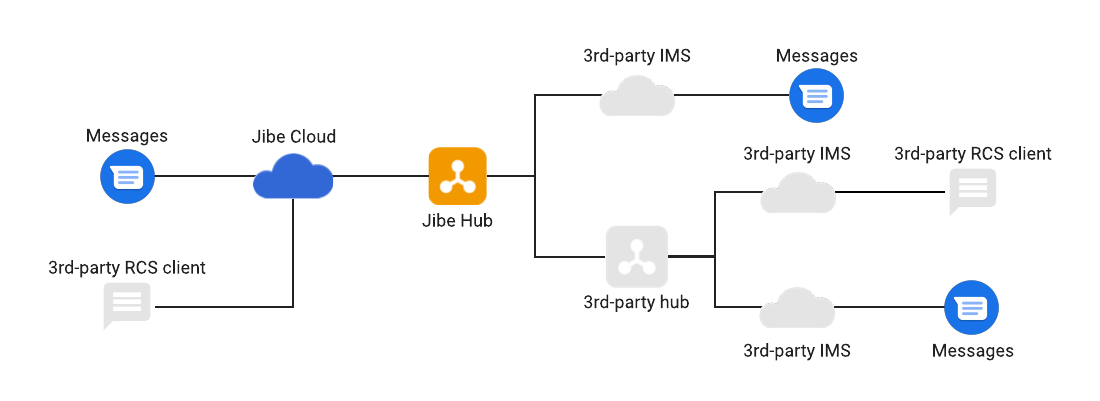
![] (https://docs.jibemobile.com/static/images/rcs-architecture.png)
RCS is an open* telecom standard. Carriers could have all deployed their own, but they are lazy and cheap, and kinda stupid.
* well, as open as any “standard” is these days.
OzarksMade is another company that has an RCS-compatible messaging client (and servers) as well that looks like Samsung Messages.
Once interconnection with Google RCS servers happens I might switch. As it stands I’ll take what amount of security Google Messages RCS offers and use Signal for the people that matter.
Right, but it requires a server, no? So is GOS operating their own server as well?
No, cell providers can operate their own RCS servers. Some do, some don’t. So there’s google, and some providers. No way to see if your recipient even supports rcs, before sending anything.
Likely they are running their own server(s), but that is an absolute guess. This isn’t the same thing as reverse-engineering iMessage, to be clear. RCS is a published spec and federation is part of the behavior. Apple’s platform is a 100% closed Apple-server-only product.
Random Internet search of RCS providers for businesses that would be running their own infra (so they can spam you) for example: https://www.txtimpact.com/blog/rcs-providers
My carrier operates the RCS servers I connect to.
Your carrier relays them through Google Jibe servers.
Why is this the first RCS app beyond Google Messages?
Asking as a dumb iPhone user that has had RCS for a while, meaning only that presumably developing another application is feasible
Well, first non-google app except for the iPhone, I guess.
Why no one makes RCS apps? no market, no demand. At least in this part of the world, the only mention I ever hears of RCS our there was “what’s that weird thing and how do I turn it off?”
My phone company removed access to RCS. I tried it and actually liked it when it released on Android. Then it stopped working. The option to activate it never passes the ‘verifying’ stage.
However, don’t expect the new functionality to be available on other Android phones. The developers have clarified that it will effectively be exclusive to GrapheneOS because it requires operating system-level changes to integrate with the Messaging app. It won’t work on a regular Android device without those changes.
What about other non-android operating systems though? I’m sure jolla would be interested
Wait actually is this just about the app? I dont see any mention of their own rcs backend, so i guess they must still be using google’s
It says they’ll be using carrier RCS where it’s available
Fascinating. I look upon Graphene’s future with great expectations.
It would be cool to see a selfhosted RCS messaging app that could be used from a browser
Big fan but not quite what I meant because your phone needs to be turned on and connected to the PC in order to use it
And you still need a phone that supports RCS (so pretty much android or ios). Kde connect doesnt help my linux phone send rcs messages.
Fair point, I was just trying to produce a product that was at least partially what you were looking for.
And twas appreciated
Lol, someone downvoter you as well. XD
Either way, thanks.
I love and hate KDE Connect.
If you’re not static IP on the same network on a fairly vanilla AP, it’s just a constant PITA.
Once I started running my cellphone mostly on Tailscale, it got better, but it just needs to do better, like some kind of syncthing p2p for coms
It also opens a bunch of wildcard ports on your PC’s firewall, which isn’t ideal
You don’t need to have a static IP. Just keep it on the LAN - don’t run it over the internet.
It does not traverse vlans well and home/work wireless and wired are seperate vlans. I have all the helpers in place, it cannot deal.
It works fine over Bluetooth. Strangely, it also works when the Linux PC is connected to the phone’s hotspot.
I think you can connect over bluetooth as well, that might work better
No, , because RCS is archaic junk.
Haha downvoters, go read the RFCS circa 1982 where they clearly stated tying users or devices to a hardware ID as the only identifier was deprecated.
Hence network protocols like TCPIP, IPX/SPX, both which provided a network ID that wasn’t necessarily tied to the Mac address of the devices.
RCS ties the UserID to the SIM of the device. Full stop.
That’s regressive. So why would Google, et Al, do this?
Game changer
Stop supporting this archaic junk.
RCS is backwards, tying device (and user) ID to a hardware address, something that was deprecated in the 1980’s.
It makes the user even easier to track because of this.
call me back when you build something better that works cross platform universally. at least there is an attempt
Signal
not a replacement for SMS.
i know, people can CHOOSE to use it for that. but it isn’t replacing sms
I only trust carrier pigeons
Yeah, it’s not their fault, they’re just trying to work with the whole damned corrupt industry
Want to get rid of your dependence on Google? Just give Google $800 and then we will help you out.
Always someone in every single thread about Graphene OS, completely missing the point…
My wife bought a used Pixel 9 Pro XL off Swappa earlier this year specifically for Graphene. No money was given to Big G.
Except for the guy who bought it from Google originally, which is where the primary demand for them to manufacture these phones comes from.
You guys talk about used phones like they don’t count but they definitely do. The only reason you say they don’t count is because the process you’re saying is amazing looks idiotic if you don’t at least pretend that you’re not supporting Google directly.
if you don’t at least pretend that you’re not supporting Google directly.
What?
Except for the guy who bought it from Google originally
The original person already bought it, that can’t be undone at this point. Sure, they might get a little bit of their money back from reselling, but not much in comparison. The alternative is it goes to a landfill, and I don’t see how that’s better.
The choice we are primarily discussing is not used/new vs landfill. The alternative you are supposed to be seeing is GrapheneOS supporting non-Google hardware. No matter which way you rationalize the current state of affairs it simply doesn’t make sense to center a de-Googled device on Google hardware. Clearly you’re willing to overlook that inconsistency but I am not.
You’re of course free to make your own choices in that regard but I do find it funny how badly everyone in this thread wants me to agree that this is a totally fine and normal way to approach the problem.
This is a stupid-ass argument and you know it.
Someone is always going to buy the latest new hot thing, and you are not going to convince that person otherwise no matter which way you slice it. You might as well capitalize on it by refreshing that device with Graphene.
And the Pixel 9 Pro XL I mentioned before, that my wife bought used specifically for Graphene, is supported by them until at least 2031. She bought it to replace her iPhone. That’s one less device Google made money on.
You can buy used Pixels for much much less than that.
I don’t think I’ve ever paid more than $250 for one that lasts years until I resell it.
That’s cool. Still a weird business model
It’s not business model as Graphine isn’t the making any money from people installing the OS on Pixels, aside from donations, and the main reason Graphine works on Pixels is the security provided by the Titan chip.
I’m aware of the rationalizations people give for paying Google money to not be on their phones anymore but that doesn’t change the absurdity of the proposition
I gave Google 350 EUR. I consider it GOS tax.
“I’ll pay ebay $120 for g00g to fuck off”
GrapheneOS being good for de-googling is a side effect of their work, not one of their priorities
GrapheneOS being good for de-googling is a side effect of their work, not one of their priorities
Right, and that’s actually a problem.
Google has for its entire existence been building a digital panopticon. And GOS project is building a defense against any kind of panopticon. The normal and natural thing to do for GOS here is to constantly evaluate political/corporate alignment compatibility in addition to hardware compatibility. That’s what’s sane and expected.
GOS project is building a defense against any kind of panopticon
I don’t think this has ever been stated as their goal. They are security-focused, not privacy-focused. A lot of privacy comes for free with the security, but it is not their objective.
Security is the same thing as privacy.
Give me an example of security which plays well with surveillance, then relate that style of surveillance-friendly “security” to what GOS is doing. Do that and I’ll give you half a point.
If you can’t think of any surveillance-friendly security, go away.
That’s an unusual take, considering it seems to be the core of their marketing strategy. The homepage on their website has two main sections and one of them has the header “No Google apps or services”.
I’d say calling that the core of their marketing is an immense stretch. They market the project as the most secure mobile OS, thats their bread and butter, and the focus of the project
I guess, but when you turn around and say “step 1 to making a more secure device is getting rid of Google services” then that sort of undercuts the point you’re trying to make here
Yeah but that’s because the apps and services are invasive and a potential security risk, not because they are trying to avoid giving money to the company
That’s just a slightly less obtuse way to say “we don’t like what Google is doing in the software space so we’re only going to support Google in the hardware space”, which sure, you can do that, but there’s no denying that it’s awkward as hell.
Take it up with them, but they are pretty single-minded about security. Pixels were (until the Motorola partnership) the only phones that met their security standards for hardware so that’s why they support them. Google Play Services are a security risk, that’s why they sandbox them. The fact that they’re made by the same people doesn’t really affect those two decisions, I guess.
Dude, fucking read the FAQ, this is answered explicitly:
This is much needed