The website decomp.dev said Thursday that it is shutting down because “the community aspect of decompilation has been broken” by AI, and that projects that once required intense collaboration between people with different skills can now be done trivially with AI. The administrator of the website said that it has become impossible to keep track of which projects are primarily human-led and which ones are done by AI.
“Historically, matching decompilation has been a brutally difficult, time consuming task, on the scale of years for any moderately-sized game with a number of active contributors,” the pseudonymous admin of decomp.dev, who goes by Encounter, wrote on the site.
But recent frontier AI models like GPT-6-Astra have made it trivially easy to decompile a game: “They are significantly better at following complex directions, cross-referencing resources for symbols or debug information, and writing natural code with enough guidance,” Encounter wrote. “It is now clear that, with the right guidance, human input, and code reviews, AI can expedite the decompilation process in a significant way. What is also now clear is that the community aspect of decompilation has been broken.”
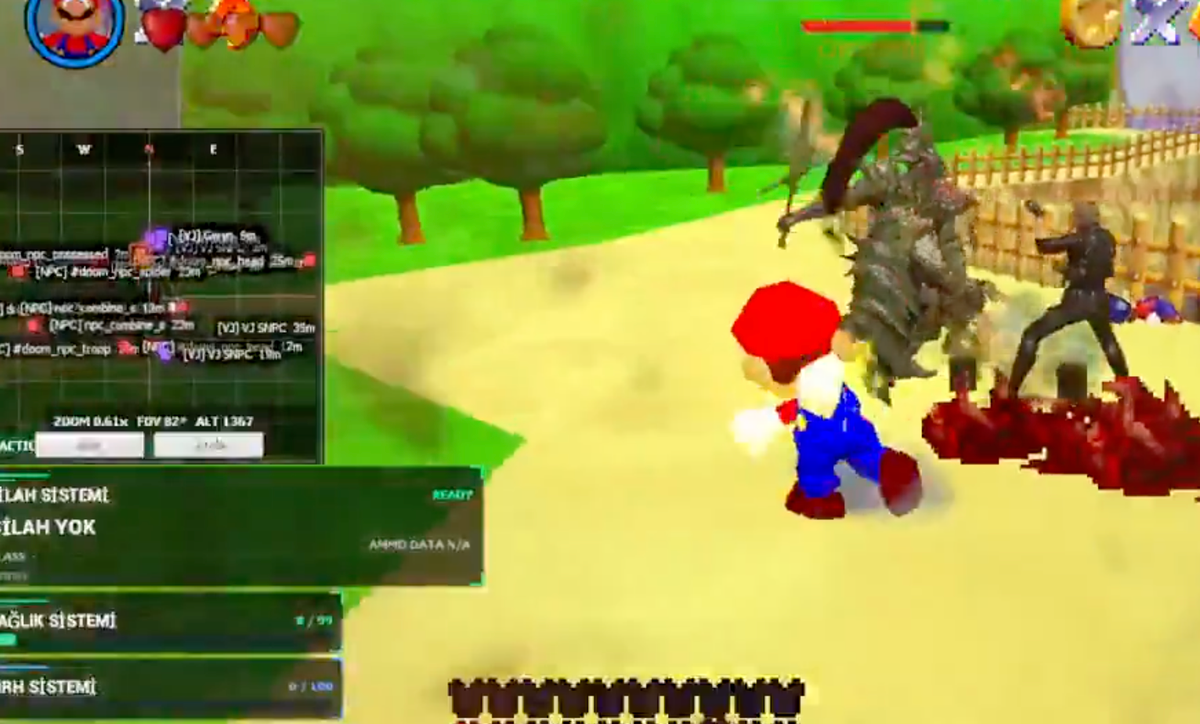
AI-powered video game decomps and recomps (recompiling code after modifying it) are everywhere. People have, for example, used AI to put Mario into Elden Ring, port games to platforms they were never designed to work on, or to combine various games in any permutations you could possibly imagine. In recent days, tools specifically designed to decomp games with AI have popped up, such as “decomp.wtf,” which promises to “point the AI agent you already use at a game you own. decomp.wtf turns it back into C, one function at a time, and checks every function byte for byte against the original.”
Decomp.dev was a collaborative website that hosted file libraries and tools for reverse engineering, re-coding, and decompiling existing video games, meaning taking an existing game and recreating its source code. Decompiling a video game can be done for a variety of reasons and is popular in a few different niches of video game fandom. Speed runners decompile video games to find potential glitches or advantages they can use to beat a game faster; hobbyists decompile video games to port them to new platforms or to emulate them (for example, making Super Mario 64 run natively on PC); modders decompile games so they can more easily modify them; archivists decompile games to recreate code that may be lost; and some people decompile games just for the challenge.
Encounter wrote that the use of AI in the community has sped things up to the point where it has become overwhelming to track human-led projects, and people using AI have taken existing, human-led AI projects and have created “hostile forks” of them, where open-source code written by humans is taken and “finished” by AI: “These kinds of hostile forks put little to no effort into meaningfully contributing to existing projects, tearing apart our community fabric.” Encounter added, “anyone with an AI subscription can manage to create a port or static recompilation that functions at a basic level […] While community members put in the effort to decompile a game, opportunists have frequently raced to release a half-baked, barely-functional port from it.”
Feeds fire into the problem, great job decomp.dev. As someone already pointed out, not everyone will spend 56k worth of tokens.
“Coring out the brain of humanity” is a phrase that comes to my mind more often these days.
People don’t use AI as a tool which is the problem. They just ask it to do a job and don’t analyze or do anything with the results. It’s made people lazier about research. I’m not trusting what a machine decided should be there.
I once use AI to build a resume for me based off the one I already had and it just made shit up.
Yeah, more people need to be taught that generative AI models are literally auto-correct like on their phones. It is the gigantic, multi-trillion-dollar, ultra high tech, ultra high powered version of auto correct, but that’s what it is. Would they trust something important that, sight unseen?
For those of us who write code, it can be handy to have an auto correct that can suggest chunks of code rather than just the next word or filling in a partially typed variable name. But you have to treat it like a suggestion, and read the suggestion, and make a conscious decision about whether that is how you want it. Giving up your agency is bad, but that is what a huge portion of the population seems to want to do at every turn. Not having to do anything is a nice-sounding option to have, but it’s not good for your brain or body.
But on top of that, as an engineer, you are also losing out on familiarity with the design when you give up that agency. I find that when I let the neural net in my head – the one made out of actual neurons – get more exposure to the internal workings of a system, it is better at helping me diagnose problems with our product more quickly and intuitively.
and don’t analyze
see: “decomp.wtf turns it back into C, one function at a time, and checks every function byte for byte against the original”
when the C code creates byte-wise identical output, then there is not much need to analyse. The code is already as good as it gets, or at least there is not much room for improvement.
or do anything with the results.
see: “People have, for example, used AI to put Mario into Elden Ring, port games to platforms they were never designed to work on”
I disagree. The way it does that is inefficient and with no understanding. I recommend you read up on things, including this blogpost : https://jpeisach.github.io/blog/ai/legoisland/decompilation/porting/reverse-engineering/2026/10/16/decomps-clout-consoom.html
It has no notion of what data and code would have looked like. Yes itll work, yes the output will be byte matching but it would be unreadable and an unmaintainable mess.
The fucking AI decomps SUCK too. I can’t be the only who who’s noticed. Bugs, performance issues, missing features, etc. Sure, technically they work, but it’s not a great experience. Every time I see a new decomp posted my very first question is “was it done with AI?”, Because if it was, I probably won’t bother with it.
AI is great about putting out something like a human half assing whatever it is doing. Looks ok at a glance but there are problems when you look into the details.
I’m so fucking sick of AI slop.
That’s because it’s just gonna be the same level as the average coder, and the average coder is a lazy pos.
Hey!
I’m also fat. A fat, lazy pos.
Let’s see the AI do that! Ha!
Have you seen their RAM requirements? The AI is very fat indeed.
I’ve been enjoying “using AI is like using a hammer to put screws it a board. It looks fine and holds together for a bit, but the littlest bit of pressure or shaking and it starts to fall apart.”
Please don’t take this as a defence of AI, but I saw this with human-led decomp projects too.
I was pretty active in the Pokemon hacking scene a few years back, and I happen to have a friend who has made a very popular rom hack (not giving names, but if you are interested in those kind of things, you probably played his game), and he told me that he tried to switch from binary hacking to decomp, but the decomp had so many insidious bugs, especially in the battle system, that he much rather keep making hacks with HMA (the currently popular universal hacking tool) rather than deal with that can of worms.
I also happen to be a huge Ace Combat fan, and the recomp project of AC6 is miles better than what the emulator offered just a year ago. If it wasn’t for AI, I would still be forced to use my OG X360 to have anything resembling a good experience on that game. The AI-led recomp is just as good as the game on original hardware, and gives me the chance to play the since-delisted DLCs too.
I don’t think this is as black and white as saying “human-made good, AI-made bad”. It’s a matter of how much care the person behind the decomp/recomp puts into it, AI or not.
Which sucks, because I think the best aspect of these projects was the community that would develop around them, the treasure trove of knowledge that someone would gather by working on them, and, as dumb as it sounds, the friends you made along the way. Some of my best friends, I got to know through the Pokemon hacking scene, and it wouldn’t have happened if everything was a matter of writing a bunch of prompts on an LLM. The fact that AI made them so easy, and that they are completely indistinguishable from human-led projects (aside from looking at the publication date) is sad. I think that’s the worst part of this situation.
You might be conflating decomps with ports that use decomps as a base.
A decompilation means taking a binary and reverse engineering source code that, when compiled, will produce an identical binary targeting the same platform.
AI has also been ruining decomps, making it a race and a numbers game, rather than focusing on quality and the production of human-readable code and the long-term documentation of how a game functions for long term preservation.
That’s a shame because if AI was used as a tool, it would still have the community helping to make the ports functional.
Hand created ports also had performance issues, missing features, etc that took years for the community to fix.
It seems like it’s a problem of over hyping the results like what has happened with AI everywhere.
I don’t think it’s a problem with overhyping the results. It’s the fact that you can get something with essentially no work. If the LLM just didn’t output anything at all but told you with a voice prompt that couldn’t be transcribed to text you wouldn’t see anyone using it. It’s the fact that it allows people to be lazy and still get output, no matter how bad the output is as long as the thing runs, that is making these chatbots so popular.
Well the real problem is the signal to noise, the noise looking almost just right, and people over excited over the novelty of “I can help now!”, even if they really can’t.
If the thing runs right, then it would be less of a problem, but it almost runs right.
Is it better than nothing, because that’s mostly what we had before. Decomp used to take years for one N64 game. Bugs can be ironed out.
It’s actually a lot tougher to iron out bugs that GenAI can’t sort out for itself than I usually see with human code. Trying to fix a bug the vibe coder couldn’t get the AI to squash is always a maddening nightmare…
From what I’ve seen from the AI rollout in my company, it’s mostly because vibecoders are not coders.
If you give a vague prompt you get basically scratchpad pseudocode quality, but if you have a well defined spec, clear coding standards, etc. you get a passable junior level output, sometimes better if it’s a particularly well trodden process like OIDC.
It’s not gonna break new ground without direct help/manual coding, but for gap-filling and simple bugs it’s become quite reliable at this point, just not in the end of amateurs.
They can’t of the trend pushes those with the knowledge how out of the scene like is clearly happening.
They don’t think it be like it is, but it do
Edit:
Okay so I went back and I figure you meant
This kind of trend pushes those with the know how out of the scene like what is clearly happening.
I’d say there’s probably a bigger opportunity for those with the know how to leverage it. People that were in for the insane puzzle level that is decompiling from what I understand can still do it.
I think either people are in it for the fun, or for opening up games. If a tool coming out and making it much easier is what gets you to quit, then you were in it for the wrong reasons.
Sounds like some flavor of gatekeeping. "Well if everyone else can do it, I quit :( ". Meh.
Hey, quit gatekeeping quitting!
Couldn’t this be mitigated by better attention on the part of the human operator? Like, use the ai to crack it open, then actually go back through and verify that everything actually works?
That requires the person to know what they’re doing, and using the AI as the tool it is. That’s a proper use of generative AI in coding, to speed up a human-driven process with oversight.
That’s not what AI slop is, AI slop is what vibe coders do. They don’t know how any of the shit actually works, they just tell the AI to do something, and modify prompting until it gives them something that works. They can’t fix the issues because they don’t know what was done in the first place.
The problem is that both use types look identical to anyone not directly involved in the project. Things like Claude don’t tell you whether it was used by a vibe coder or a responsible developer, it looks exactly the same.
Sight amendment, they prompt until it gives them something that looks like it works, based on their often incomplete understanding of the target use case and likely laziness to explore all the nuance of the result.
Like people who were heavy users of Photoshop that tried the vibed knockoff lamented that it failed at all but the most basic image editing tasks. The vibe coder likely never used Photoshop for anything more than casual use, so they couldn’t have vetted the result properly even if they were inclined to.
It’s a shame that it’s leading to the close of a community that could have actually put together a better system for adapting to this. That sense of community that died to this would have been a great way to team up and vet each others work. Even vibe coders could have had a part, they may not have the skill to actually program things but they clearly have the time and interest.
Problem is just the sheer volume of shit to vet. Vibe coders get a bit pissy when folks seemingly can’t “keep up” with their volume of shit and just keep shitting more and making an unmanageable backlog. They figure if the AI in their unskilled hands can get it over 80% there, then surely a skilled person can somehow use AI to knock out that last bit fast.
Issue being that however far the vibe coder got, the skilled people they look to finish it off could have just gotten it that far themselves just as quickly. It’s like someone sending a search to Google on someone’s behalf and pastes the result and thinking that was somehow way easier than the person just searching Google themselves.
Define “too easy” because the last AI decomp I saw was a 600ish megabyte Pokémon game for the DS that cost the guy $56k worth of tokens and was ultimately pointless because the actual source code had leaked ages ago.
cost the guy $56k worth of tokens

Could this be the future of decompiling other Pokémon games and even more complex titles?
Lmao pray whatever god you have that they won’t remove or hike the subscription plan then.
Saw someone about a decomp that after $250k was only 80% accurate.
That said, it is a use case that AI should be viable for: a known source of truth that can be used to verify a guess and drive retries. It needs a lot of tries, hence token costs, but it should, given enough retries, be able to let much “get it”.
Yeah but is there really any value in something like that? Maybe for corporate espionage, I guess, but that 250k is still heavily subsidized; these AI companies are hemorrhaging money. What happens when the capex fountain runs dry; is anyone going to pay a million dollars in tokens to get an 80% accurate decomp of an old pokemon game?
For that price, I could create my own GPU farm of local models, instead of wasting money on tokens.
First of all, lol.
Second of all, decompiling a binary in a clean room setting is not pointless just because leaked source code exists, because the decompilation can legally be used to make projects based on it whereas the leaked source code cannot be touched without facing the wrath of Nintendo lawyers.
Now, using AI to decompile a binary will likely not produce human-readable code, and will ultimately be pointless for things like studying code, producing high quality ports and mods, etc., but if a human or a group of humans did it, it can be extremely useful.
Think the people assuming that clean room principles apply to this scenario are way too optimistic about the legality.
The most prominent clean room example was making a knockoff of the IBM BIOS. The thing is it was cloning a programming interface surface, and doing so with zero visibility into the object code, but instead an api reference written by people who did study the object code. Wine is even more clean room, guessing at a viable implementation based on black box observation of Windows behavior with zero understanding of the object code.
Translating object code into source code is not “clean room”. But even if it were, we are talking about a deep clone down to the implementation and up through the human presentation. Not merely some programming interface details with a completely novel backend and with other code mostly owning the presentation to a human.
People keep thinking they find a technical loophole but consistently get shot down the millisecond a rights holder takes note.
See the myriad of fan projects that don’t even try to clone a game engine but implement a game a new way, they get shut down hard.
I doubt legality is a shield against them suing you and honestly I’m not entirely sure they’d lose; many judges aren’t technically literate enough to understand the difference between leaked source and decompiled. Better hope the lawyers you can afford are better than the ones they can.
Define “too easy”
…they go into detail in the article.
It doesn’t say how much these decamps cost, or what quality they are. I don’t think burning a years salary on this is “easy”.
I don’t think burning a years salary on this is “easy”.
Burning money is actually quite easy.
Building a Lamborghini is easy, just go to the dealership and pay hundreds of thousands of dollars.
Building a Lamborghini is not equivalent to spending money.
Wasting the money on a Lamborghini is easy.
Paying an AI for a decompilation is not the same as doing the decompilation. You’re buying the decompilation; that doesn’t mean the act itself was easy to accomplish.
Hey, now we’re saying the same thing :)
It’s easy to spend the money on AI doing the decompilation. It’s not easy to do the decompilation itself.
This seems kind of sad.
It is sad! I’ve always loved being part of small communities and to see one get destroyed like this and so quickly is really sad.
Wow I kind of expected a better headline from 404. The website makes it clear that it’s not about being easy, it’s about it being low effort and antisocial.
You don’t think low-effort and easy can be the same?
Easy is answering the question “what is 2 + 2?”
Low effort is using a calculator for the answer.
The tone carries clearly different connotations, one way makes it sound more positive and the other makes it sound more negative. Tone is very important in a headline.
In some cases, but the text of the article implies that a big issue with the AI decomps is that they’re low quality, so it’s not really making it easier to do the actual work involved so much as it’s automating low effort slop
Yeah, a big issue more broadly. Congratulations, it technically achieved a very narrow requirement, but unlike what we are used to, the result is difficult to take forward, neither human nor GenAI are able to reasonably modify the result in precise ways.
The loss of skills as this continues to happen is going to be devastating. At least as people moved from machine level coding to higher compilers there were still programming methodology and awareness of how and why things work. One problem with AI in anything is that it’s difficult to keep it focused on just one thing, it likes to wander and do other changes too, which for coding will end up changing and breaking stuff and the human has no idea why since it wasn’t even assigned.
We’ve lived for a while in a consume and trash society where the ability to fix things yourself is gone, and now it’s in coding.
Eh, I’m really not worried. The decomps are interesting as a proof of concept, but they really really aren’t very good, and once the VC funding runs out and the vibe coders have to invest actual money, you’ll see a big decrease in these decomps and vibe coded apps. The world of foss will largely return to the hands of the people who actually care about the quality of their code.
I agree that there will (probably) always be some amount of people that have passion enough to do these things themselves, but this is still a big problem as it erodes current infrastructure for the transfer of knowledge. The state of these scenes by the time the bubble finally bursts will likely be vastly diminished and in little state to help the new or tenacious people that are left.
So I don’t disagree, but at the same time I also don’t see many people relying on these vibe-coded apps, or including them in crucial points within software stacks. For example if a vibe-coded Mario Kart decomp project gets orphaned it doesn’t really have widespread repercussions.
Where do you get the wandering AI idea from?
The worst I get when I tell pretty much any hosted/service frontier model to do a specific focused task is “I also noticed [potential bug/issue/code smell], if you would like me to do anything about it, just say the word”.
My own experience and understanding that if allowed, it will recreate existing code that is working with something a bit different, that may still work. It’s the code version of the image generation where it narrows in on one aspect of the picture to your specifics, but something in the background is altered slightly. And yes, image generation is a different type of model, and inpainting can avoid this, AND minimizing letting the context window get too large, but that’s just it. If given freedom, it will drift over time. In the end it’s probabilistic math, and without heavy guardrails things change.
If the human is in control, aware of what’s being done, and the AI is used as a tool to help the human and not a black box to get a result without intervention, then a lot of this is avoided. Is it being used like this? Some places. Most places, no.
What the fuck are you on about? You’re talking about abstract nonsense.
Coding AI doesn’t “recreate existing code that is working with something a bit different”.
If I have, say, a website or an app, and I tell the AI that on this and this page/screen there’s a green button, and I want that to turn blue, it goes in, finds the button (either via code analysis or via an emulator/browser + visual identification), finds its style, and changes the colour.
If I tell it to figure out what the very same button does, it does the same flow, except it goes further by tracing that button’s click event, and then all the logic that is bound to it, even through multiple layers (e.g. in a well designed app that click event is handled in the ViewModel of the specific screen, which in turn calls a Use case, which in turn incorporates business logic and calls Repositories, which in turn call the data storage or networking layers, or maybe even both…), then explains what happens.
But let me give you a real world example. Just the other day I was working on a tool, a web flasher for a handful of different ESL (Electronic Shelf Label, e-ink based price tags). It involves connecting to a USB probe, plugging the probe into the board via spring contacts, and then running specific code to install custom software on the device so it talks to my smarthome. Most of the work was lift and shift - the flashing logic existed as C/Python code, so it was quickly ported to JavaScript, utilising WebUSB.
But it was ugly. The only thing I told the damn thing was to “make it look good”. You know what the AI did?
It went onto the official site of the project, grabbed the fonts, colours, sizes, etc., and put that style on the flasher page. The only “went out of its way” thing it added was a “virtual e-ink display” emulating a tag, that was actually on the project site (https://openepaperlink.de/). It didn’t go around changing the flashing code, the device detection, etc., it just covered the changes I requested - which were pretty broad.
What AI does depends 100% on the prompt. Image editing is a bit finicky because most image editing models come with their own LLM beyond the visual engine itself, and that LLM tends to be super limited, without any thinking loop, so it does what it first recognises (and often doesn’t recognise negation - e.g. telling it to NOT change something, will result in specifically that change, because, again, the LLM included is tiny and crappy).
But you can’t compare a “hey I asked AI to do X to my image and it did twelve other things” to working with codegen AI - especially the reinforced loop models like Claude or Codex that literally goes on to work out any issues by expanding on its own task while the goal remains what you set it to. So if you tell it to design a fancy website for you, you get a fancy website - but e.g. it won’t start working on creating an investment portfolio or do sports bets for you.
My own experiences with various projects aren’t abstract nonsense. You said yourself the prompt matters, and a broad prompting over time on the same project does drift. You haven’t seen it, then good. I can’t speculate on why. I’'m not even saying it always happened, only that because of how these things work, probability does come into play.
The last is a strawman, I was using image generation as an example of visual drift that’s more obvious that code. Nor did I imply drift as in a totally different direction - as I stated, the new routines would still work sometimes, but would differ in their approaches or use different variable names. Not all drift is critical or breaks things, but it’s there. It’s not an abstract.
I dislike genAI as much as the rest of you, but…
If you can’t beat ‘em, join ‘em.
If anyone is looking for alternatives that are useful it looks like recomp.fyi is doing a good job.
Why does the owner of decomp.dev sound so defeated? Aren’t their legitimate decomp projects still existing and going strong?
EDITED to be a less charged question. Im realizing how devastating this situation actually is.And I’m quite sad to see something that I care so deeply for being destoyed
Out of interest, are you part of any decomp communities? As a contributor to one, I can absolutely confirm this is a period of turmoil with the rise of AI PRs, people doing low effort changes that weren’t even human verified etc.
Without wanting to sound gatekeepy, this was a niche community project I got into a few years ago where we were all researching and learning and communicating as a proper open source team, but it does feel like those days are mostly kinda over? Or at least most projects that might have spun up in such a way no longer will
And I think the main sadness here is I’m seeing this in my real life work and it’s now extending into my hobbyist projects too
Decomp.wtf which was referenced as one of the tools has been archived today, because it’s author realised it’s killing the community. Cats out of the bag now, so not sure how that will help.
???
I can understand decomp.dev shutting down because it was mainly a tool to motivate the community, but decomp.wtf shutting down sounds silly. I find it hard to believe that someone made a tool for AI agents and then say “I didn’t realize some people don’t like AI”. Why would he even make it if he’s going to shut it down in a few days and be upset that people were using it? The original description straight up told people to use it to finish other people’s public decomps, so it’s not like he was considerate and careful about how the project was used until now.
https://decomp.wtf/ site has their statement, GitHub is archived.
Will see if it’s still dead at the end of the week I guess.
Oh no, ai killing hobbies and art and fun oh nooo such a surprise if only anybody had seen this comingggg
This feels like an asshole move. Instead of providing a central location for tracking, encouraging open sourcing and continued development the dude just threw his hands up in the air and said “I give up”.
Like yeah, the AI usage sucks and those versions are buggy as hell but at least it’s a start for some games and people can continue the work to improve it.
But now without easy tracking every script kiddy and vibecoder are just going to assume they are the first and make another project somewhere then repeat the same work that has already been done.
I get that life happens or people move on from a project but damn dude, let someone else takeover or GTFO of the way.
It may feel that way, but it’s not an asshole move. We are all struggling with mental health and existential dread in the face of what sometimes seems to be a genuine polycrisis that includes an AI apocalypse. Some people deal with this stress more effectively than others, but it doesn’t make someone an asshole when they just can’t take it anymore and you’ve gotta expect some people are going to crash out pretty hard. This is a lot milder than how some people are going to inevitably crash out, and this is not going to be the only situation like this.
The asshole part is not letting others fork it or open sourcing it. Like I said, I get that life happens but the dude is literally blocking progress.
They do it for free, if they decided to just take the thing down at least respect that. If people want to have a similar stuff they can just, idk, vibecode it since it’s the in thing today.
Maybe they have reasons, maybe they’re good reasons, maybe they’re not. It doesn’t matter, because we aren’t entitled to know why they don’t want to release the code, and we aren’t entitled to the code either. Nobody should be obligated to open source their code (unless money has changed hands). It’s not exactly proprietary cutting edge research that will take decades to rediscover and reimplement.
I’m sorry, but I hate how people think free services that never promised to be open source, don’t ask anything of you, don’t take advantage of you, and don’t sell your data, somehow because they got popular because of that, makes them owe the community even more than anyone would ever believe that exploitive freemium or even paid, commercial software does. Nobody’s pretending that Adobe owes us the source code because millions of people paid for Photoshop. We all acknowledge they’re an asshole, but we know we’re not getting the source code and many people still pay for it.
So why does a free website owe its community even more than that? Like the fact that they were kind and generous to the community for a few years means they are now obligated to be a complete doormat and give you everything you want from them upon request or be called an asshole? They don’t get any personal rights and if they try to have any, they’re an asshole, but commercial software does it all the time and it’s okay because it’s just expected that commercial software is going to be an asshole? WTF? We just call anybody who doesn’t give us their source code upon request an asshole? Shut down the whole internet and from now on only provide services that are completely open source from day 1? Sure, sounds great. Anyone who’s got code you like and is just trying to survive this capitalist dystopia without releasing all their source code for free is an asshole, fuck them. Got it.
I think the AI luddites are playing into the hands of the wealthy, if they aren’t actually secret allies.
The problems with AI boil down to individuals having too much personal influence over humanity, no different from personal ownership of factories, banks, politicians, PMCs, and churches.
Everyone telling me and other weak individuals to not use local AI, are basically trying to strangle a new form of democracy in the cradle.
My friend. That chatbot isnt giving you individual freedom. It’s owned by a billionaire that is cooking our planet, and it is being tasked with doing the fun creative jobs faster than you.
The end goal isn’t individual democracy. It’s to make you work 10 hour shifts in the lithium mines to pay for your weekly subscription to Claude v47, which will make soulless content for you to absorb in the short period between your mining job, and the second job you need to pay for food and rent.
I use a local AI open weight model, Qwen Next-Flash. I don’t pay for a subscription, and it isn’t doing the ‘fun creative jobs’, it is digging through code and building programs.

You’re not a programmer are you.
Nope. Math and coding aren’t my passions. Leave that stuff to the people who enjoy doing those things, or to AI.
Far as I am concerned, the important thing is the result, not the process. I don’t have the money to hire a person, so it falls to AI to realize my intentions.